What Is Your Shipping Policy?
We offer free shipping. Orders are shipped via USPS, FedEx Ground or FedEx SmartPost. Your Air filters will ship within 1 business day and delivery time after shipment ranges between 2 - 5 business days depending where you’re located in the contiguous United States.
What Is Your Return Policy?
We have a no hassle return policy. We offer free shipping on all returns within 180 days. We’ll email you a shipping slip to send your order back for a full refund if you’re not 100% satisfied.
What Is Your Customer Satisfaction Policy?
Your satisfaction is guaranteed. If you ordered the wrong size, we’ll send a replacement. If we messed up your order, we’ll fix it. If your filter was damaged during shipping, we’ll send a new one. If we still can’t get it right, we’ll provide a 100% refund.
Why Are Air Filters Important?
Having clean fresh air in your home is important to staying healthy. The air in your home circulates almost twice an hour; a quality air filter will capture the dust, bacteria, pollen and other pollutants before we breathe them in. Having quality clean air filters is essential for small children, and for those who have asthma and suffer from allergies.
Changing out your air filters will help your HVAC system run smoothly longer. A healthy HVAC system keeps monthly electricity bills down, and you will prevent expensive repairs. Dirty air filters will make your HVAC work harder, which can lead to expensive energy bills and HVAC repairs. Regularly changing air filters improves HVAC efficiency and helps keeps maintenance costs down.
How Do I Find the Correct Air Filter Size?
Finding the correct air filter size is simple. Check your existing filter for the size printed on its frame, and verify each return vent because homes may require two or three different filter sizes. If the size is missing, measure the filter’s length, width, and depth. If no filter is present, measure the filter slot or opening carefully. Remember that the nominal size printed on a filter may differ slightly from its actual dimensions. Accurate measurements help ensure a proper fit, prevent air leakage, and maintain effective filtration.
Why Do I Need to Change My Air Filter?
An unclean air filter will cause multiple issues which can affect your wallet and your family’s health. An unclean air filter reduces air quality in your home and can affect your health, especially for children with allergies and asthma. A dirty air filter will cause your HVAC system to consume more energy and increase your electricity bills. An unclean air filter is one of the main reasons why a HVAC system fails. Change your air filters regularly for your family’s health and to save on energy.
Can I Order a Custom-Sized Air Filter?
Filters Delivered offers a wide selection of air filter sizes in 1-inch, 2-inch, 4-inch, and 5-inch depths. If you cannot find a matching size, we may be able to arrange a special order or create custom-sized air filters to meet your needs. Measure your existing filter's length, width, and depth, and note any size printed on its frame. Visit our Contact Us page to email us these dimensions. Our team will help you identify available options, particularly for bulk orders requiring nonstandard filter sizes.
Which Air Filter Is Right for My HVAC System?
Start with your HVAC system manufacturer’s recommended filter specifications, including the MERV rating and filter thickness. MERV 8 may suit many residential systems, while MERV 11 or MERV 13 can provide greater filtration for households concerned about allergens and airborne particles. However, higher MERV ratings can increase airflow resistance. Before choosing a higher-rated filter, confirm that your HVAC system can handle it. The right filter balances filtration needs with your system’s airflow requirements.
When Should I Change My Air Filters?
We recommend changing out your air filters every 60-90 days. The filters we sell last up to 90 days, but this time period is dependent on your environment and the type of filter you have installed. Factors such as outside air quality, pets in house, # of occupants in home, and pollen, can affect the life expectancy of your filters. Again, we recommend at minimum you change your air filters every 3 months if not sooner.
What Is the Difference Between Nominal and Actual Air Filter Sizes?
Nominal size is the rounded size commonly printed on an air filter or product listing. Actual size refers to the filter's physical dimensions, which may be slightly smaller. Check your existing filter's label and measure its length, width, and depth when confirming the correct replacement.
How Do I Know Which MERV Rating My HVAC System Supports?
Check your HVAC system's owner's manual or manufacturer's recommendations before selecting a MERV rating. Your system must support the filter's airflow resistance and dimensions. If the recommended rating is unclear, contact an HVAC professional to help identify a suitable filter for your equipment.
What Does the Merv Rating Mean?
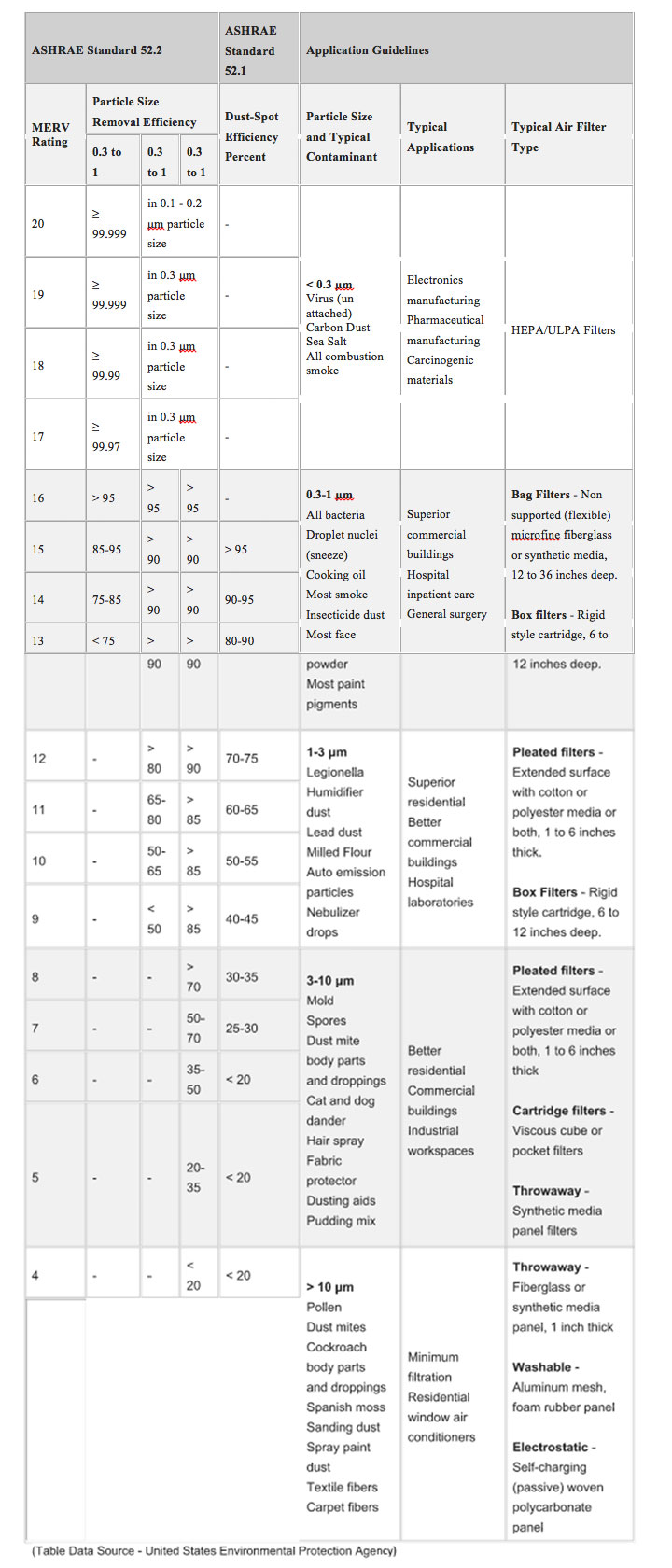
MERV stands for Minimum Efficiency Reporting Value, this is a filter rating system devised by the American Society of Heating, Refrigeration and Air conditioning Engineers (ASHRAE) to standardize and simplify filter efficiency ratings for the public. The higher the MERV rating, the higher the efficiency of the air filter. Simply stated, a MERV 13 filter will remove smaller particles from the air than a MERV 8 filter.
For you this means that you now have the ability to effectively compare one filter to another. In general, any MERV 8 or 11 air filter will perform about the same as any other MERV 8 or 11 filter. The MERV rating only applies to efficiency. If allergies or asthma are your concern, we suggest you choose a MERV 11 filter or higher.
- A MERV rating of 13 means the filter is 89-90% minimum efficient at capturing measured particles such as bacteria, tobacco smoke, and particles that make you sneeze.
- A MERV rating of 11 means the filter is 80-85% minimum efficient at capturing measured particles such as humidifier dust, lead dust, milled flour, auto emissions and other fumes.
- A MERV rating of 8 means the filter is 60% minimum efficient at capturing measured particles such as mold spores, hair spray, fabric protector, dusting aids, cement dust and pet dander.
- A MERV 4 filter rating, which we don’t sell, are typical fiberglass throw-away filters and below with just a 6% minimum efficiency at capturing the measured particles like pollen, sanding dust and larger dust particles.
MERV Rating Chart