


MPR vs. FPR vs. MERV: Decoding the Hardware Store Filter Aisle
Aug 13th 2026
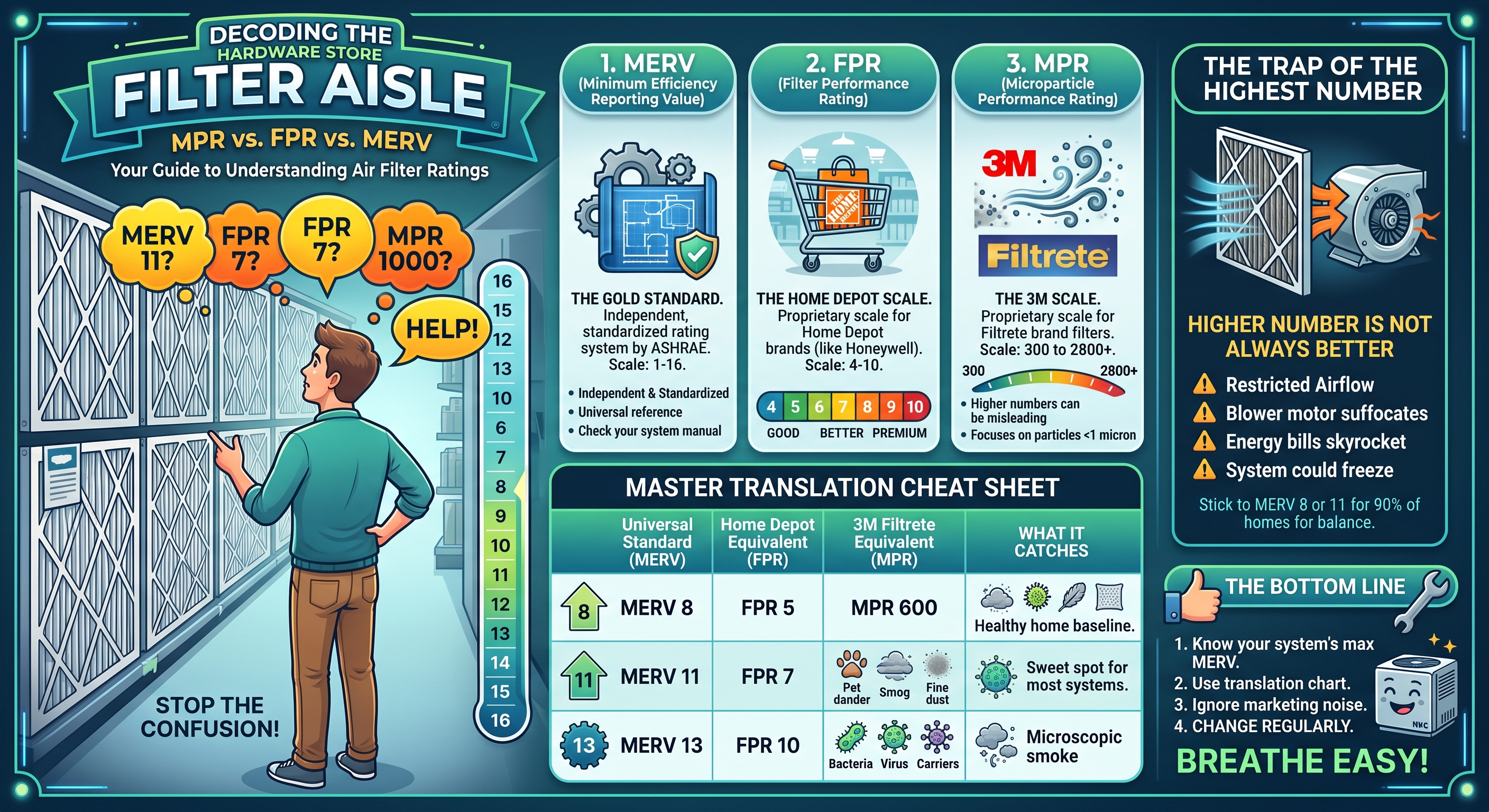
The Truth About the Alphabet Soup
1. MERV: The Industry Standard
2. FPR: The Home Depot Scale
3. MPR: The 3M Scale
MERV vs MPR vs FPR: Full Comparison
|
Feature |
MERV |
MPR |
FPR |
|
Created by |
ASHRAE (independent) |
3M / Filtrete |
The Home Depot |
|
Scale |
1–20 |
300–2800 |
1–10 |
|
Works across brands? |
Yes |
No |
No |
|
Third-party verified? |
Yes |
No |
No |
|
Used by HVAC professionals? |
Always |
Rarely |
Rarely |
|
Best used for |
All purchasing decisions |
Within Filtrete only |
Within Home Depot only |
Which filter rating should you trust first?
Start with MERV first because it is the common reference point across the filter industry and the rating most likely to appear in HVAC guidance. Once you know the MERV level your system can handle, you can translate FPR or MPR labels into a comparable range and shop with more confidence.
Here is a practical translation guide for common residential filters:
- MERV 8 usually lines up around FPR 5 and MPR 600. This is a common baseline choice for capturing larger household particles such as dust, lint, and pollen.
- MERV 11 often compares with FPR 7 and MPR 1000 to 1200. This range is a popular middle ground for homes with pets, everyday dust, and general indoor air concerns.
- MERV 13 is commonly compared with FPR 10 and MPR 1500 to 1900. This level targets finer particles, including smoke-related particles and some microscopic contaminants, but it is not right for every system.
These comparisons are useful shopping shortcuts, not a substitute for checking your HVAC system’s requirements. Filter design, thickness, pleat count, and airflow resistance can vary, so two filters with similar ratings may not behave identically in every system.
The Master Translation Cheat Sheet
| The Universal Standard | Home Depot Equivalent | 3M Filtrete Equivalent | What It Catches |
| MERV 8 | FPR 5 | MPR 600 | Dust, pollen, and lint. The baseline for a healthy home. |
| MERV 11 | FPR 7 | MPR 1000 to 1200 | Pet dander, smog, and fine dust. The sweet spot for most systems. |
| MERV 13 | FPR 10 | MPR 1500 to 1900 | Bacteria, virus carriers, and microscopic smoke. |
The Trap of the Highest Number
A simple filter-buying checklist
Before you buy your next filter, run through these steps:
- Check the exact size. Use the size printed on your current filter or measure carefully if the label is missing.
- Look for the MERV rating. If the package only shows FPR or MPR, find the approximate MERV equivalent.
- Match your home’s needs. Pets, dust, pollen, nearby smoke, and household sensitivity can all influence the level you choose.
- Respect your HVAC system. Do not assume a higher rating is safe for every furnace or air handler.
- Replace filters regularly. Even a good filter becomes a problem when it is overloaded with dust.
- Keep it consistent. Once you find the right size and rating, reordering the same style helps avoid last-minute aisle confusion.
This checklist keeps the decision practical. You are not trying to win a numbers contest; you are trying to protect airflow, capture the particles that matter in your home, and avoid buying the wrong filter because the package looked impressive.
The Bottom Line
Frequently Asked Questions
Are MERV, FPR, and MPR measuring different filter qualities?
No. MERV, FPR, and MPR all indicate how effectively an air filter captures airborne particles of different sizes. MERV is an industry-standard rating system, while FPR is used by Home Depot and MPR is 3M Filtrete’s proprietary rating system for residential air filters.
Which rating should I use as my starting point when comparing filters?
Start with MERV, the standard rating system used to measure an air filter’s particle-capturing efficiency. Check your HVAC system’s recommended MERV range before choosing a filter. Then, use FPR or MPR ratings to compare compatible filters across different brands and retailers.
What is the best filter rating for most homes?
For most homes, the article recommends MERV 8 or MERV 11, along with their FPR and MPR matches. MERV 8 is a solid base for dust, pollen, and lint, while MERV 11 catches smaller particles like pet dander, smog, and fine dust without being too hard on most systems.
Why shouldn't I automatically buy the highest-rated filter?
Higher-rated filters are denser, so they can restrict airflow in a standard home HVAC system. If the filter is too restrictive, the blower motor may struggle, energy costs can rise, and the system may even freeze. The best filter is not always the highest one; it is the highest rating your system can safely handle.
How do MERV 11, FPR 7, and MPR 1000 compare?
They are roughly equal on different scales. The chart shows MERV 11 with FPR 7 and MPR 1000 to 1200. That makes it a strong choice for pet dander, smog, and fine dust while still keeping airflow healthy for many systems.