



What Happens to the Air You Breathe Every 10 Minutes at Home?
May 22nd 2026
What Happens to the Air You Breathe Every 10 Minutes at Home?
You probably think of your living room as a calm, still environment. You are sitting on the couch, watching television, and nothing is really moving. But invisible to the naked eye, your home is basically a wind tunnel.
A properly functioning HVAC system pulls in and pushes out the entire volume of air in your house roughly four to six times an hour. That means every 10 to 15 minutes, the exact air you just breathed out is going on a wild journey through your walls.
Here is exactly what happens during that 10 minute cycle and how to make sure you are not just inhaling the same dust over and over again.
The 10 Minute Cycle: A Play by Play
Let us follow a single cubic foot of air on its journey.
-
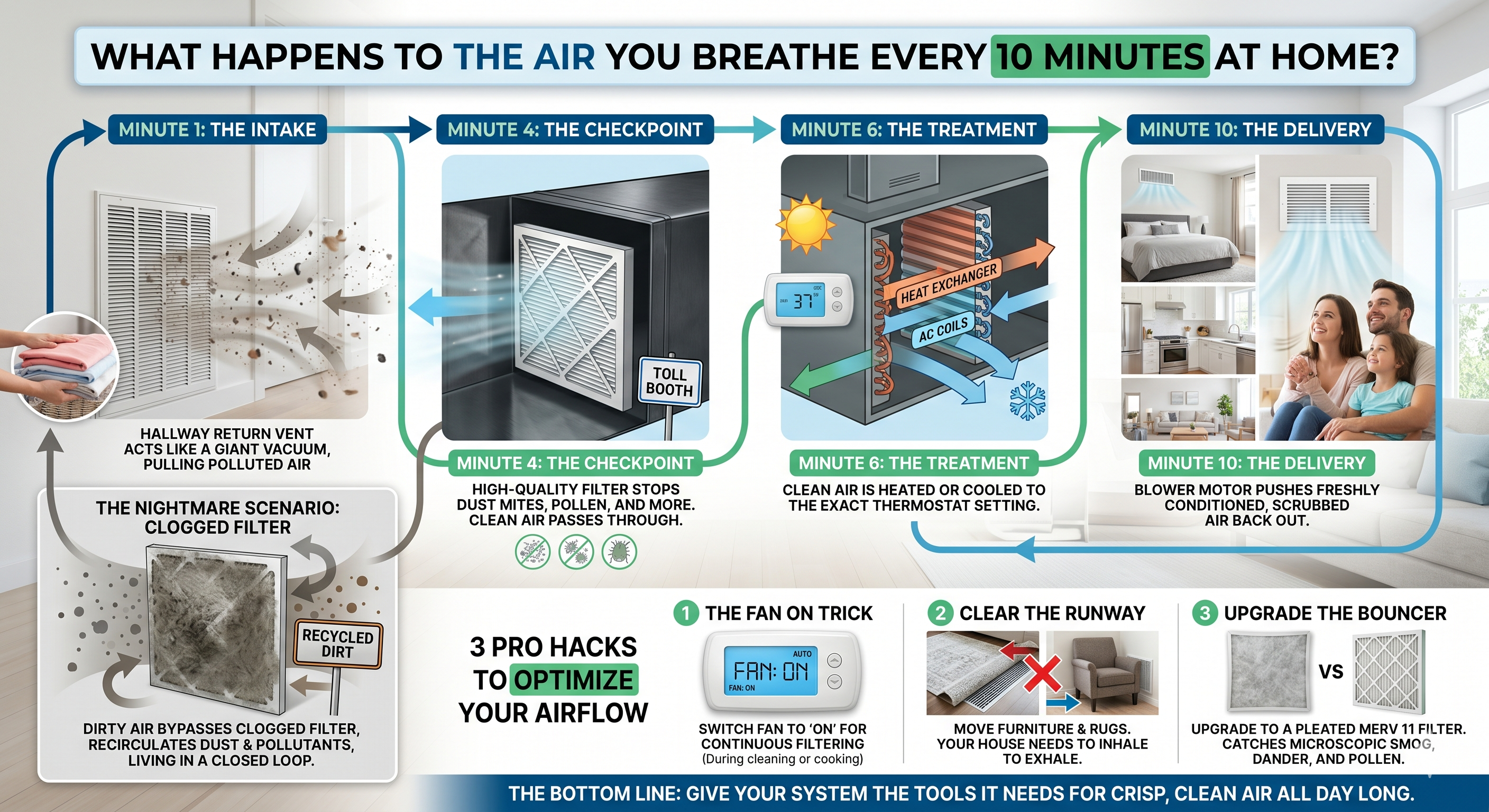
Minute 1: The Intake. You just finished folding laundry on the sofa. You kicked up microscopic lint, a little bit of dog dander, and some normal household dust. The large return vent in the hallway acts like a giant vacuum, sucking all of that polluted air into the ductwork.
-
Minute 4: The Checkpoint. The air travels down the dark metal tunnels until it hits the toll booth. This is your HVAC air filter. If you have a clean, high quality filter, this is where the journey ends for the dust mites and pollen. The clean air passes right through.
-
Minute 6: The Treatment. The newly cleaned air gets pulled over the heat exchanger or the icy air conditioning coils. It is cooled down or heated up to match the exact temperature you set on your thermostat.
-
Minute 10: The Delivery. The blower motor pushes this freshly conditioned, scrubbed air back out through the supply vents in your bedroom, kitchen, and living room. You take a deep breath, and the cycle starts all over again.
The Nightmare Scenario: When the System Fails
That 10 minute cycle sounds great in theory. But here is the catch. It only works if your filter is actually doing its job.
Think about what happens when you forget to change your filter for four months. That toll booth becomes a solid brick wall of gray fuzz. When the hallway vent sucks in that laundry lint and dog hair, the air hits the clogged filter and physically cannot get through.
Because the blower motor is incredibly powerful, it will just suck the dirty air right around the edges of the cardboard frame. That means all the dust, skin cells, and pet dander bypass the filter entirely, travel over your expensive internal equipment, and blow straight back into your face. You are essentially living in a closed loop of recycled dirt.
3 Pro Hacks to Optimize Your Airflow
You want those 10 minute cycles to work for you, not against you. Here is how to hack the system.
1. The Fan On Trick
Look at your thermostat. The fan setting is probably on Auto. That means the air only cycles when the house needs to be heated or cooled. If you are doing heavy cleaning or cooking a smelly dinner, switch the fan setting to On. This forces the system to continuously cycle and filter the air every 10 minutes, even if the temperature in the room is already perfect.
2. Clear the Runway
Your system cannot suck in the dirty air if the vents are blocked. Go walk around your house. If you have a rug covering a floor grate or a heavy armchair pushed directly against a wall return vent, move them right now. Your house needs to inhale to exhale.
3. Upgrade the Bouncer
A cheap fiberglass filter will only catch boulders. Upgrading to a pleated MERV 11 filter ensures that your system catches the microscopic smog, pet dander, and pollen during every single 10 minute cycle.
The Bottom Line
Your home is breathing with you. Every 10 minutes, your HVAC system is trying to give you a fresh, clean environment. Do not sabotage the process with a cheap or clogged filter. Give your system the tools it needs, and it will reward you with crisp, clean air all day long. Discover the Sizes, Merv ratings and fast free shipping to get it there as soon as you need it with FiltersDelivered.com