


What's with the different Air Filter rating guidelines such as MERV, FPR, & MPR?
Posted by Ryan on Jul 15th 2015
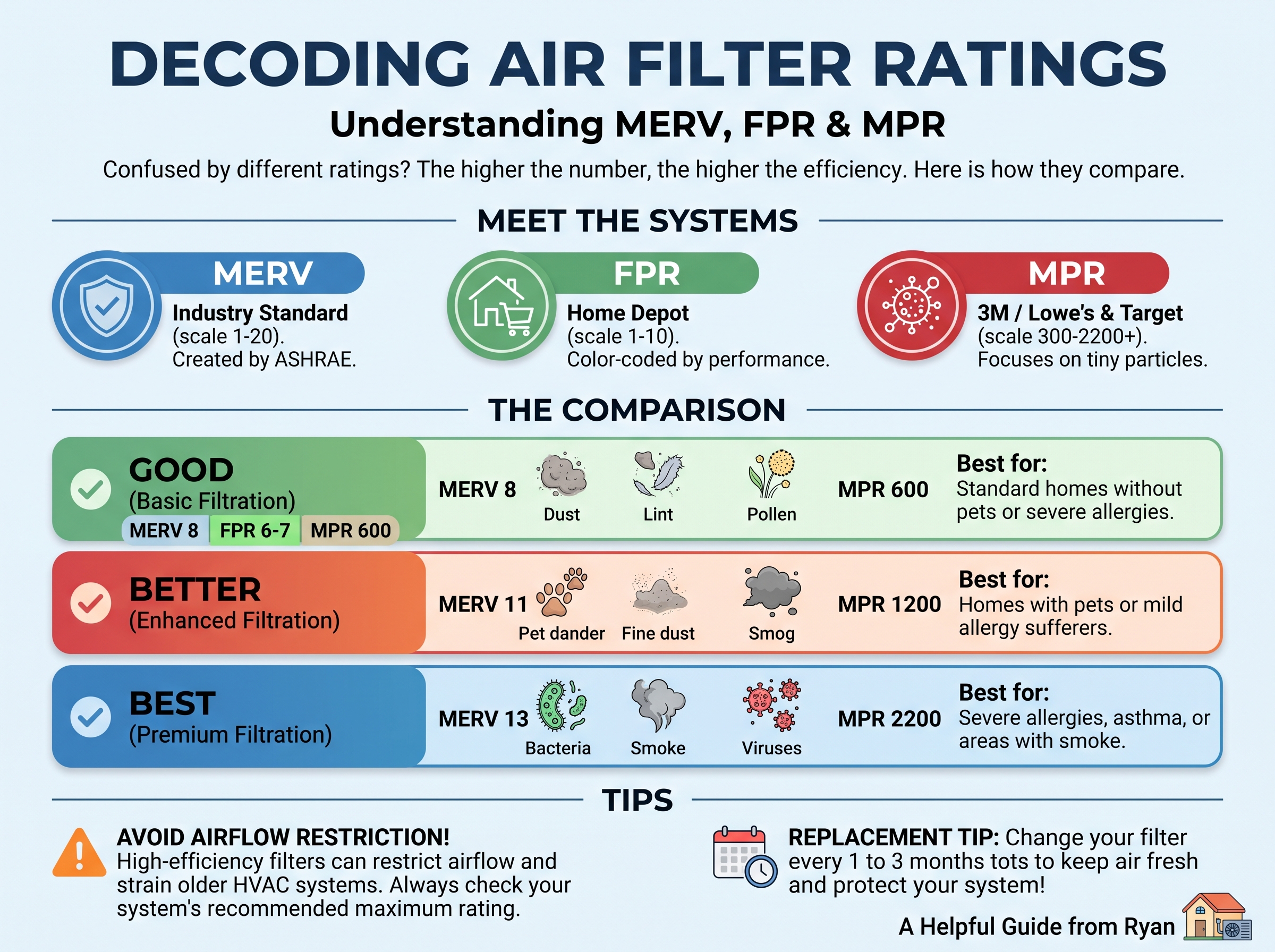
If you have ever stood in the air filter aisle at your local home improvement store, you have likely felt the confusion of trying to compare apples to oranges. One brand boasts a "MERV" rating, another uses "FPR," and a third advertises "MPR."
What do these acronyms mean, and how do you know which one is actually best for your home?
While the letters differ, the core concept remains the same: the higher the number, the higher the efficiency of the filter. Here is a breakdown of the three main rating systems and how to translate them so you can buy with confidence.
The Three Main Rating Systems
1. MERV (Minimum Efficiency Reporting Value)
This is the gold standard of the HVAC industry. Created by the American Society of Heating, Refrigerating, and Air-Conditioning Engineers (ASHRAE), the MERV scale universally ranks filters from 1 to 20 based on their ability to capture particles. Most residential filters fall between MERV 4 and MERV 13.
2. FPR (Filter Performance Rating)
If you are shopping at Home Depot, you will see the FPR system. This is a proprietary rating scale created by the retailer that ranks filters on a 1 to 10 scale. To make things easier, FPR also color-codes its packaging (Green, Red, and Blue) to indicate the level of filtration.
3. MPR (Microparticle Performance Rating)
Created by 3M for their Filtrete brand (commonly sold at Lowe's and Target), the MPR system focuses specifically on a filter's ability to capture microscopic particles—specifically those between 0.3 and 1 micron in size. The MPR scale ranges from 300 up to 2200+.
The Ultimate Conversion Chart
If you know your system requires a MERV 11 filter, but you are shopping at a store that only sells MPR or FPR filters, use this conversion guide to find your exact match:
| Industry Standard | Home Depot System | 3M / Lowe's System |
| MERV 8 | FPR 6 - 7 (Green) | MPR 600 |
| MERV 11 | FPR 7 - 9 (Red) | MPR 1200 |
| MERV 13 | FPR 10 (Blue) | MPR 2200 |
Which Rating is Right for Your Home? (Bonus Guide)
Understanding the numbers is only half the battle. Here is what those ratings actually mean for your indoor air quality:
The "Good" Tier (MERV 8 / FPR 6-7 / MPR 600)
-
What it catches: Dust, lint, pollen, and dust mites.
-
Best for: Standard residential homes without pets or severe allergy sufferers. These filters provide excellent airflow, ensuring your HVAC system doesn't have to work too hard.
The "Better" Tier (MERV 11 / FPR 8-9 / MPR 1200)
-
What it catches: Everything above, plus pet dander, smog, auto emissions, and finer dust particles.
-
Best for: Homes with indoor pets, mild allergy sufferers, or houses located near busy roads.
The "Best" Tier (MERV 13 / FPR 10 / MPR 2200)
-
What it catches: Everything above, plus bacteria, microscopic viruses, smoke, and sneeze airborne particulates.
-
Best for: Individuals with asthma, severe allergies, compromised immune systems, or homes in areas prone to wildfire smoke.
A Quick Word of Caution
It is tempting to simply buy the highest-rated filter available, but denser filters restrict airflow. If you install a MERV 13 filter in an older HVAC system designed for a MERV 8, the system will have to work overtime to pull air through the thick pleats. This can lead to frozen coils, higher energy bills, and a burned-out blower motor. Always check your HVAC manual for the maximum recommended MERV rating.
No matter which rating you choose, the most important step for maintaining air quality and system efficiency is replacing your filter regularly—typically every 1 to 3 months.
I Hope this helps in your comparisons of air filter quality and performance.
Kind regards,
Ryan