

Why Your AC Cannot Reach 68 Degrees When It Is 100 Degrees Outside (And Why That Is Normal)
Aug 7th 2026
It is the hottest week of the year. The asphalt is melting, the sun is punishing, and you just want your living room to feel like a walk in a refrigerator. You walk up to the thermostat, crank it down to 68 degrees, and wait.
Four hours later, the system is still roaring, but the thermostat is completely stuck at 78 degrees. Panic sets in. You assume your air conditioner is broken, and you start mentally preparing to pay a massive repair bill.
Take a deep breath. Your air conditioner is probably not broken at all. It is simply bound by the laws of physics. Here is the hard truth about extreme heat, and why demanding 68 degrees in the middle of a heatwave is a recipe for disaster.
The 20 Degree Rule
To understand why your living room is warm, you have to understand a concept called the temperature differential. In the HVAC industry, this is known as Delta T.
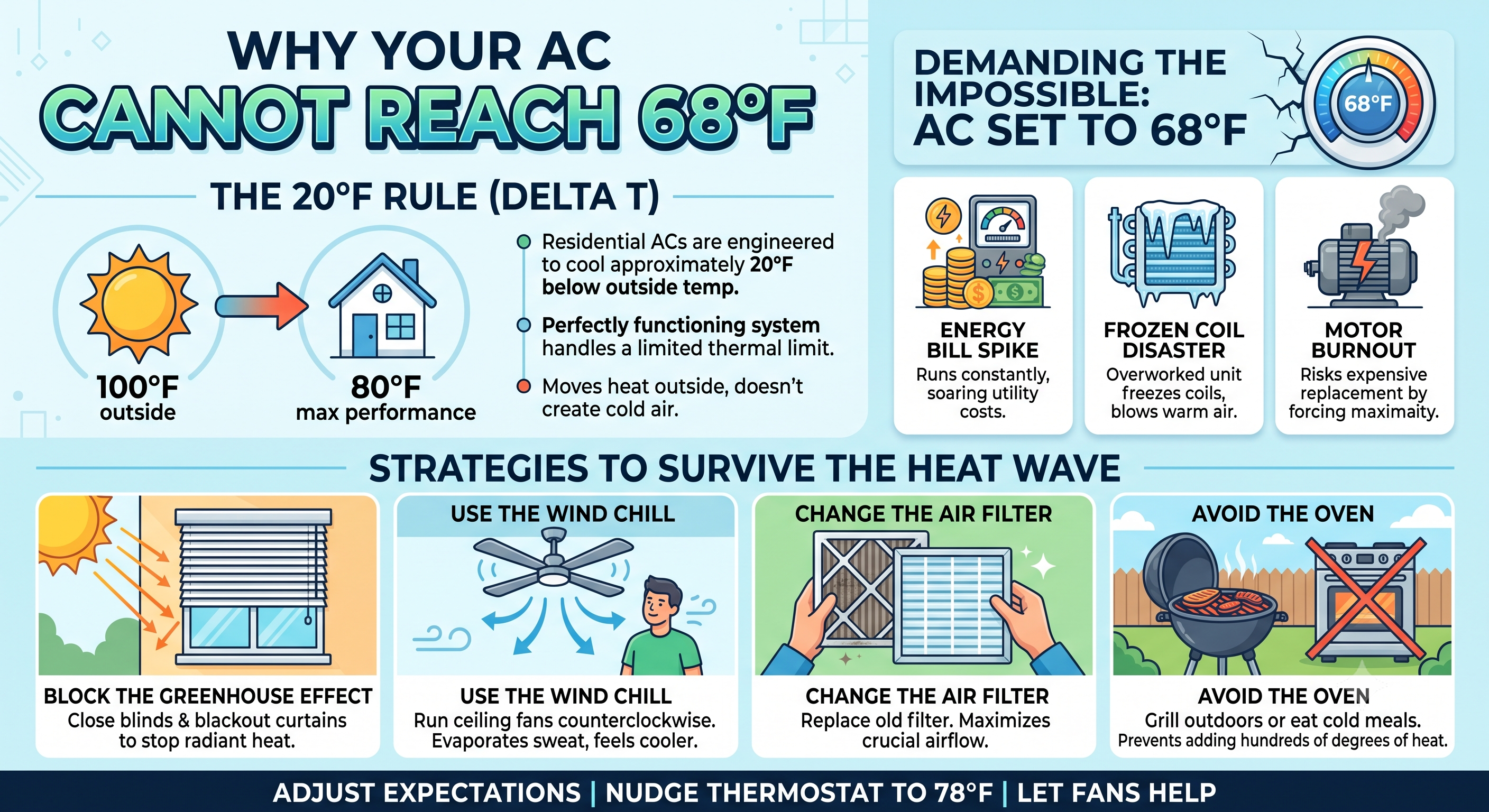
Residential air conditioning systems are not designed to create magic winter wonderlands. They are engineered to cool your home by approximately 20 degrees from the outside temperature. That means if it is 100 degrees in your backyard, an indoor temperature of 80 degrees is actually a sign of a perfectly functioning system.
Your air conditioner does not create cold air. It removes heat from the air inside your home and pumps it outside. When the outside air is scorching, the machinery simply hits a thermal limit. It cannot physically move the heat fast enough to overcome a 30- or 40-degree difference.
Heat gain works against your thermostat
Your home is constantly collecting heat. On mild days, the AC can remove that heat quickly enough to reach a low setpoint. On extremely hot days, the heat gain becomes much harder to overcome.
Major sources of heat gain include:
- Attic heat: A poorly ventilated or under-insulated attic can radiate heat down into living spaces.
- Windows: Direct sun through glass can warm rooms quickly, especially on west- and south-facing sides.
- Air leaks: Gaps around doors, windows, recessed lights, and duct openings allow hot outdoor air to enter.
- Duct losses: Leaky or uninsulated ducts in attics or crawl spaces can lose cooled air before it reaches rooms.
- Indoor activity: Cooking, laundry, electronics, lighting, and extra occupants all add heat.
- Humidity: Moist air feels warmer and makes the AC work harder because it must remove moisture as well as heat.
This is why one room may feel comfortable while another stays stubbornly warm. The issue is not always the thermostat. It may be the way heat moves through the building.
When a warm house points to an AC problem
A home that cannot hit 68 degrees during extreme heat is not automatically a sign of failure. However, some symptoms do suggest the system needs service. If the AC used to cool better under similar conditions and now cannot keep up, something may have changed.
Watch for these warning signs:
- Weak airflow from vents: a clogged filter, dirty coil, blower issue, or duct restriction can reduce airflow and limit cooling.
- Air from the vents is not cool: If supply air feels only slightly cooler than room air, the system may have a refrigerant, compressor, coil, or airflow problem.
- The outdoor unit runs constantly but struggles: Long run times are normal in extreme heat, but constant running with poor cooling deserves attention.
- Ice appears on refrigerant lines or coils: Ice is not a sign that the system is extra cold. It often points to restricted airflow or refrigerant issues.
- Energy bills rise sharply without a clear reason: A sudden efficiency drop may mean the equipment is working harder than it should.
- Some rooms are much hotter than others: Uneven cooling may come from duct problems, poor balancing, insulation gaps, or an undersized return system.
If these issues are present, the answer to “why your AC cannot reach 68 degrees when it is 100 degrees outside” may involve both outdoor heat and a repair or airflow problem.
What Happens When You Demand the Impossible
If you set your thermostat to 68 degrees on a 100-degree day, your AC will never reach the target. Because it cannot hit the target, it will never shut off. This creates a dangerous chain reaction for your equipment.
-
The Energy Bill Spike: Running a heavy compressor for ten hours straight is incredibly expensive. Your utility bill will skyrocket, but your comfort level will not change at all.
-
The Frozen Coil Disaster: An overworked AC running constantly without a break will often freeze its indoor coils into a solid block of ice. Once it freezes, it stops cooling completely, leaving you blowing warm air around a hot house.
-
The Motor Burnout: Forcing a machine to run at maximum capacity for days on end dramatically shortens its lifespan. You are risking a thousand-dollar compressor replacement just to chase a temperature you will never reach.
How to Survive the Heat Wave
You cannot change the weather, and you cannot break the laws of physics. But you can hack your home to feel significantly cooler than the thermostat says it is.
| The Strategy | How It Works | The Result |
| Block the Greenhouse Effect | Close all blinds and blackout curtains on your south and west-facing windows. | Stops radiant heat from baking your floors and furniture. |
| Use the Wind Chill | Turn on your ceiling fans and make sure they are spinning counterclockwise. | Creates a breeze that evaporates sweat, making your skin feel up to four degrees cooler. |
| Change the Air Filter | Put a brand new, clean filter into your system. | Maximizes airflow, allowing your struggling AC to push as much conditioned air as possible. |
| Avoid the Oven | Do not cook dinner on the stove or in the oven. Grill outside or eat cold meals. | Prevents you from adding hundreds of degrees of unnecessary heat into your kitchen. |
Smart thermostat settings protect comfort and efficiency
A more realistic thermostat setting during extreme heat is often in the mid-70s, especially during peak afternoon hours. Many people find that 74 to 78 degrees feels comfortable when humidity is controlled, and air is circulating. Ceiling fans can help occupants feel cooler without forcing the AC to chase an unrealistic setpoint.
Try this approach on very hot days:
- Set the thermostat to a steady, reasonable temperature before the hottest part of the day.
- Avoid dropping the setpoint dramatically in the afternoon.
- Use fans in occupied rooms, but turn them off when rooms are empty.
- Close blinds or curtains on sunny windows.
- Avoid oven use and heat-producing chores during peak heat.
- Replace dirty air filters before heavy cooling periods.
- Keep supply and return vents open and unobstructed.
Small changes reduce the load on your AC. They also help the system run more steadily, which improves humidity removal and overall comfort.
The Bottom Line
When the forecast predicts triple-digit heat, it is time to adjust your expectations. Nudge your thermostat up to 78 degrees, turn on a fan, and let your air conditioner do its job at a sustainable pace.
Stop fighting the weather. Your system is working exactly as hard as it can, and giving it a realistic goal is the absolute best way to protect your home and your wallet. Let FiltersDelivered.com help keep your family cool by keeping the airflow of your HVAC system at its highest level. With great pricing and fast free shipping, we got you covered!
Frequently Asked Questions
Can an air conditioner cool a house to 68 degrees when it is 100 degrees outside?
An AC may reach 68°F in some homes, but it is not always realistic during 100°F weather. Outdoor heat entering through windows, walls, attics, and air leaks can exceed the system’s cooling capacity. A higher indoor setting may be more practical during extreme heat.
How much indoor temperature difference can an AC normally maintain during extreme heat?
No single indoor-to-outdoor temperature difference applies to every home. Cooling depends on equipment size, insulation, windows, ductwork, humidity, and heat gain. During extreme weather, a properly operating AC may maintain a comfortable temperature without necessarily reaching a very low thermostat setting.
Why does my thermostat show 68 degrees but my home still feels warm?
A thermostat measures temperature at one location, not throughout the entire house. Rooms farther away may receive less conditioned air or gain more heat from sunlight, poor insulation, or air leaks. Humidity can also make a space feel warmer even when the thermostat displays 68 degrees.
Why is one room hotter than the rest of my house during a heat wave?
One room may become hotter because it receives more direct sunlight, has less insulation, or sits above a hot attic. Duct leaks, restricted airflow, or an inadequate return-air path can also contribute. These factors can create noticeable temperature differences even when the AC is operating normally.
Can high outdoor humidity make it harder for an AC to cool a home?
Yes. An air conditioner must remove both heat and moisture from indoor air. When humidity is high, the system has additional moisture to manage, which can affect comfort and cooling performance. A room may therefore feel warmer or stickier even when the measured temperature appears reasonable.
How can I tell whether extreme outdoor heat or an AC problem is causing poor cooling?
Search for changes in system performance rather than temperature alone. Weak airflow, unusually warm supply air, ice on coils or refrigerant lines, sudden energy increases, or major temperature differences between rooms can indicate a problem. If you notice these symptoms, an HVAC professional can inspect the system.