

The MERV Trap: Why the Most Expensive Air Filter Could Break Your AC
May 8th 2026
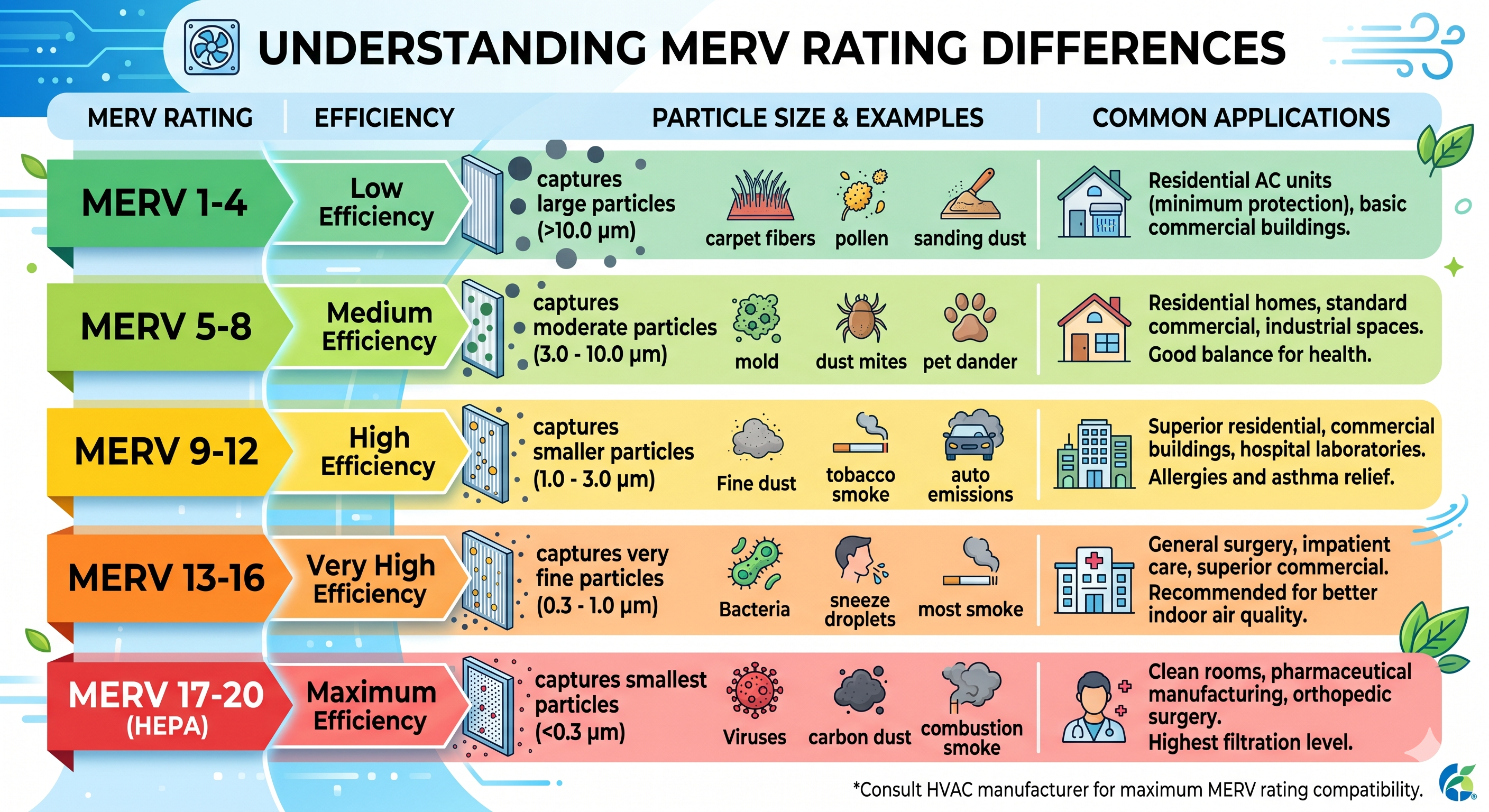
We are wired to think bigger is always better. We want the upgraded engine, the extra-large coffee, and the maximum-strength laundry detergent. So, when you stand in a hardware store looking at a wall of air filters, it is natural to reach for the MERV 16.
It has the highest number. It has the highest price tag. It promises to capture everything from microscopic particles to bacteria. It must be the best choice for your home, right? Not necessarily.
Installing an ultra-high MERV filter in a standard residential HVAC system can restrict airflow and increase static pressure. If your system was not designed to handle that level of filtration, the result can be reduced comfort, higher energy use, and unnecessary strain on HVAC components.
Here is why buying the "best" filter on the shelf might actually be the wrong choice for your home.
What Does MERV Mean?
To understand the problem, you first need to understand what MERV means. MERV stands for Minimum Efficiency Reporting Value. It is a rating used to measure how effectively an air filter captures particles of different sizes.
A lower-MERV filter generally allows more air to pass through while capturing larger particles. A higher-MERV filter can capture smaller particles, but it may also create more resistance to airflow. Think of a low-MERV filter like a chain-link fence. It catches larger particles while allowing plenty of air to pass through.
A high-MERV filter is more like a much denser barrier. It can capture smaller particles, but the denser filter material can make it harder for air to move through. Your furnace and air conditioner are designed around specific airflow requirements and need to move a large volume of air through the home to heat or cool it properly.
When you install a high-efficiency filter that creates more resistance than your HVAC system can handle, airflow can drop and static pressure can increase.
How High Static Pressure Can Affect Your HVAC System
When an HVAC system has to work against excessive airflow resistance, several problems can follow.
Higher Energy Use
Restricted airflow can make the blower work harder to move air through the system. Depending on the equipment and operating conditions, this can contribute to higher energy consumption.
Reduced Comfort
When less air moves through the ductwork, you may notice weaker airflow from your vents. Some rooms may become harder to heat or cool evenly.
Greater HVAC Strain
Severely restricted airflow can contribute to HVAC problems. For example, inadequate airflow across an air conditioner's evaporator coil can contribute to coil icing. On a furnace, insufficient airflow can contribute to overheating and safety shutdowns.
That means a filter upgrade should not be based on MERV rating alone. Your HVAC system's airflow requirements matter too.
What MERV Rating Is Best for a Home?
There is no single MERV rating that is right for every home or HVAC system.
The right filter depends on your equipment, filter size, system design, indoor air quality needs, and the filter rating recommended by the manufacturer.
As a general guide:
|
MERV Rating |
What It Does |
The Verdict |
|
MERV 1–4 |
Captures larger dust, lint, and bunnies |
Too Weak. These protect the furnace but do absolutely nothing for your air quality. |
|
MERV 8–11 |
Catches pollen, pet dander, and fine dust. |
Just Right. This is the perfect balance of excellent air filtration and healthy airflow for 90 percent of homes. |
|
MERV 13–16 |
Catches smog, bacteria, and microscopic particles. |
Too Strong. Unless your HVAC technician specifically upgraded your system to handle these, stay away. |
For many residential systems, MERV 8 to 11 can provide a practical balance between filtration and airflow. However, do not assume that every home should use the same rating.
If your HVAC manufacturer recommends a specific MERV range, follow those specifications.
How to Get Better Filtration Without Restricting Airflow
If you have allergies, pets, or other indoor air quality concerns, you may want better filtration. That does not mean you should automatically choose the highest MERV filter available.
Try these practical steps instead.
1. Replace Your Filter Regularly
A filter becomes increasingly loaded with dust and particles as it operates.
A clean MERV 8 filter can allow better airflow than a heavily loaded filter of a higher rating. How often you need to replace the filter depends on your home, pets, indoor air quality, filter size, and HVAC system.
Check the filter regularly and replace it according to the manufacturer's guidance or when it becomes visibly loaded.
2. Check Your HVAC Manual
Your HVAC equipment has specific airflow requirements.
Before moving to a higher MERV rating, check the owner's manual or manufacturer specifications. If you are unsure whether your system can handle a particular filter, ask a qualified HVAC professional to check the system's static pressure and airflow.
Do not assume that a higher MERV rating is automatically better for your equipment.
3. Consider Your Fan Settings Carefully
Running the HVAC fan continuously can increase air circulation and filtration time, but it also means the blower operates more often.
If you use a continuous fan setting, make sure it is appropriate for your HVAC system and your home's comfort needs. A properly selected filter is still important.
Why the Highest MERV Filter Is Not Always the Right Choice
A MERV 16 filter can provide a high level of particle filtration, but that does not mean it belongs in every residential HVAC system.
The filter needs to match the equipment.
A filter that is too restrictive can reduce airflow and put additional strain on the system. A filter that is too low may provide less particle filtration than your household needs.
The goal is to find the right MERV rating for your HVAC system, rather than simply choosing the highest number on the shelf.
Choose the Right MERV Filter for Your HVAC System
Before buying your next air filter, check your HVAC manufacturer's recommendations, consider your home's air quality needs, and make sure the filter provides suitable airflow.
At Filters Delivered, you can find residential air filters in different MERV ratings to match a range of HVAC filtration needs. Choose the rating that fits your system, replace your filter regularly, and help your HVAC system maintain proper airflow.
With fast, free shipping, FiltersDelivered.com makes it easy to order the filters you need and have them delivered to your door.
Frequently Asked Questions About MERV Air Filters
1. Is a higher MERV rating always better?
No. A higher MERV rating generally means greater particle filtration, but it can also create more resistance to airflow. The correct MERV rating depends on your HVAC system and indoor air quality needs.
2. Can a MERV 16 filter damage my AC?
A MERV 16 filter can create more airflow resistance than a lower-MERV filter. If your HVAC system is not designed to handle that resistance, restricted airflow can contribute to problems such as reduced cooling performance, coil icing, and increased system strain.
Check your HVAC manufacturer's recommendations before using a MERV 16 filter.
3. What is a good MERV rating for a residential HVAC system?
MERV 8 to 11 is commonly used in residential HVAC systems, but there is no universal rating for every home. Always check your HVAC manufacturer's recommended filter specifications before choosing a MERV rating.
4. How often should I change my MERV air filter?
The replacement schedule depends on the filter, HVAC system, home size, pets, occupants, and indoor air conditions. Many homes need filter changes every 1 to 3 months, while homes with pets, allergies, or higher particle loads may need more frequent changes.
Check the filter regularly and follow the manufacturer's recommendations.
5. Does a higher MERV filter use more electricity?
A higher-MERV filter may create greater airflow resistance. If the HVAC blower has to work harder to move air through a restrictive filter, energy use can increase. The actual effect depends on the HVAC system, filter condition, and operating conditions.
6. What MERV filter should I buy for my AC?
Start by checking the HVAC manufacturer's recommended MERV rating and filter size. If you need higher filtration because of dust, pollen, pets, or other indoor air concerns, make sure the selected filter is compatible with your system before moving to a higher MERV rating.